There’s a moment in Empire of Light when the quiet, unspoken understanding of mental illness is broken. For a moment, the audience become doctors, but by this point, whatever our formal assessment may be it’s too late. After some erratic behaviour from Hilary (Olivia Coleman), the floor manager of a cinema, her boss Donald (Colin Firth) accuses her of being ‘a schizophrenic.’ It’s a low blow, a (perhaps calculated) way of making her look bad in front of his wife, after Hilary has just revealed that Donald has been cheating on her, with Hilary as the somewhat reluctant mistress. ‘The condoms are in the top right-hand drawer in his office,’ Hilary says calmly, before walking away from the chaos, leaving behind her stupefied colleagues, an angry wife, and Donald like a deer in headlights. At this point in the film, there is no denying that Hilary is unwell, but the proclamation of her ‘diagnosis’ hits both Hilary and the audience. It leaves her struck dumb and us wondering: how much of it is fair or true?
Often, the portrayal of mental illness in film features characters who are not only defined by it, but whose experiences are predictable, and whose behaviour is ‘understood’ by the viewer. From there, it’s easy for an audience to categorise: ‘oh he was obviously quite depressed,’ ‘the character is highly anxious,’ ‘they go insane towards the end,’ etc. It’s not that any of these observations are wrong, of course, we all use shorthands to understand what a character is going through in a film, just as we use these descriptors in real life to make sense of and often legitimise someone’s existential struggles. But what hits differently about Donald’s accusation in Empire of Light is that, while dramatic, we know it isn’t ‘true’ — or certainly not the whole truth. By this point in the film, we understand that Hilary and her experience are complex. It’s too late in the film to pigeonhole her. Whether she is schizophrenic is beside the point; we may have witnessed erraticism, mania, sadness, aggression, but who are we, and more so who is Donald, to diagnose her?
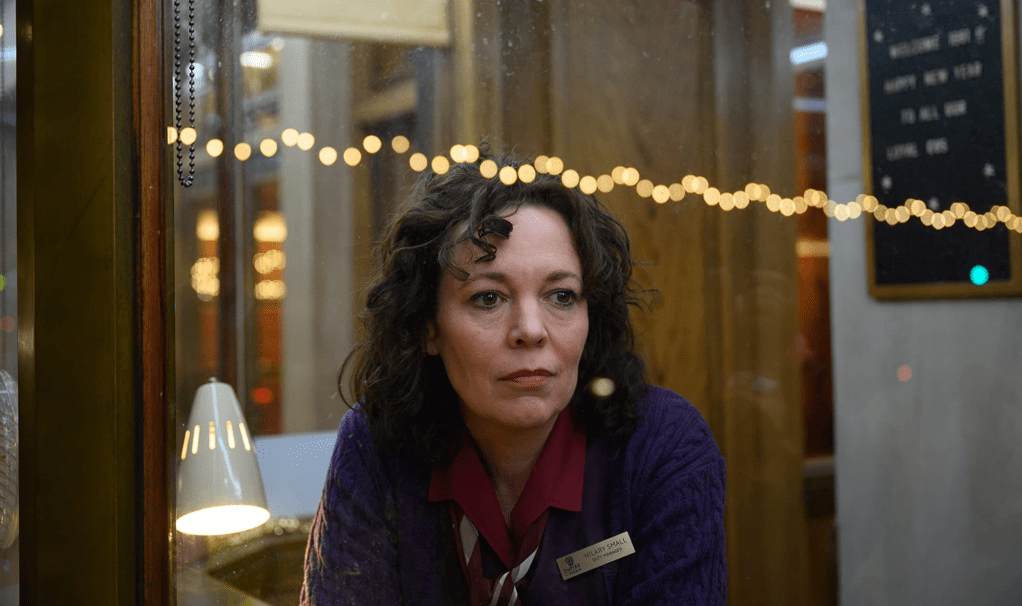
Empire of Light carries one of the most sensitive portrayals of mental illness I have seen in film in a long time. It’s clear from early on that Hilary is lonely and a bit guarded. There is a hint that, while she may not be suicidal (at least not obviously so), she toys with the idea of death, or at least imagines what it would be like to disappear. At the same time, Hilary is able to speak normally with her colleagues, to enjoy their company even. She turns up to work every day and keeps her house in relative order. She keeps medicine in her cabinet, which we see her contemplate, somewhat regretfully, before taking. We also learn quite early that Hilary sees a psychiatrist, who may be well intentioned in his work but seems a disinterested listener and unattuned to Hilary and her more particular needs. It’s not until the end of their appointment when Hilary discloses, quite offhandedly and in a very understated manner, that she ‘feels a bit low.’
When Hilary is tasked with onboarding a new employee, Stephen (Michael Ward), a friendship emerges. In many ways this seems due to their respective loneliness: Hilary in recovery from a stint in a psychiatric hospital and Stephen, a young, Black, aspiring architecture student, both of them bound by the constraints and discrimination of a Thatcherite Britain. And while Hilary’s condition makes her feel that she cannot be in the world, that the world is too much for her, Stephen yearns to be in it: to study, to live without fear, to live without prejudice. We see, along with the new friendship, a change in Hilary, a kind of confidence, a renewed perspective on life: she sings, she dances, she laughs. The pair fall into a sexual relationship.
While the romance does not last, partly because of Hilary’s undisclosed condition and partly because of Stephen’s doubt of their racial difference, their friendship endures. It’s another beautiful quality of Sam Mendes’ film that the complexities of romance and friendship are shown to not be easily distilled or separated. Even after their breakup and Hilary’s dramatic demise, Stephen continues to show concern, and goes out of his way to make sure she is okay.
At the climax of the film, Stephen finds himself cooped up with an acutely manic Hilary. In her now-shambolic apartment there is a knock from the police. Hilary is defensive at first, steadfast in her resolve to keep the door locked and pretend she is not home. It is not until she hears a familiar voice, a social worker, when we see her aggression dissipate and her face soften. Under Hilary’s instruction, Stephen steps into a wardrobe to hide, while she grabs a suitcase, and sits facing the door, wincing with each barrage as the police force entry to her apartment. By the time the door is thrown open, Hilary is sitting still, and fearful but without fight. ‘Oh look, you’re already packed,’ exclaims the social worker kindly, and without a glance back, Hilary leaves with her entourage. It’s only then Stephen emerges, dutifully having stayed with her until her apprehension, but exhausted and clearly out of his depth.
At its core, Empire of Light is a film about friendship. Hilary and Stephen’s relationship is explored in depth, but this theme is also highlighted in the collegiality of the cinema staff. They accept Stephen into the fold with little fuss and grow quickly to love him as one of their own. During a brutal attack on the cinema by a violent mob of marching skinheads, Stephen is bashed brutally and to within an inch of his life. Hilary holds him in the ambulance as he is rushed to emergency and waits, faithfully, in a similar way he did for her before she was carried away for psychiatric care. In a moving exchange between Hilary and Delia, Stephen’s mother (Tanya Moodie), Hilary’s sense of shame is eased as it becomes clear that despite Delia’s knowledge of their past relationship, she acknowledges the dedication and friendship that Stephen has so relied on.
Sam Mendes has offered a delicate exploration of the possibilities and trauma of living with mental illness. Hilary’s struggle makes her sensitive and open to bonding with Stephen, who shows her both kindness and vulnerability. At the same time, her ways of being in and relating to the world are impeded by her illness as she struggles to find the sweet spot between her debilitating downs and dysfunctional highs. Despite this, Hilary doesn’t give up, and it’s thanks to Stephen in many ways that she continues as she does, in her steady, persistent commitment to being alive, which, as we all know, is harder for some than for others.
Stephen gets a place in University; Hilary is left behind. By this time, their romance has long faded, but their friendship firmly established. How refreshing to feel that it’s the course of a friendship and not a romance that can transform a person. And how refreshing it is to see someone experience illness in a way that bears no obvious and neat resolution but that conversely allows space for optimism and joy in recovery. To write about illness is complex — get it wrong and it will perpetuate stigmatising ideas about what it looks like. Get it right, and those with experience of being or caring for someone who grapples with illness can, hopefully, feel as though their nuanced way of ‘living with it’ is not reduced to a few pills, a manic psychosis, and suicidal ideations. In its own way, Empire of Light is an extension of the friendship it portrays, a reminder that our lives intertwine, and tender, vulnerable experiences of being unwell can be, in the right circumstances, safe to share, our relationships healing and that the stories we tell about ourselves can be recalibrated.

 Gabriella Florek