I’m often heartened by the sight of other people strolling through art galleries: no agenda, no cause to rush, just taking their time to meander through and pausing at whatever captures their attention. Sometimes the attention is directed towards the artwork themselves, and at others it’s the shuffle of a security guard, the attempt to hush a small, small child on the border of a tantrum, or the gentle pursuit of a friend who has taken off somewhere. These spaces, particularly when constructed with a deliberate social and cultural awareness in mind, can serve as a haven for solo introspection and contemplation.
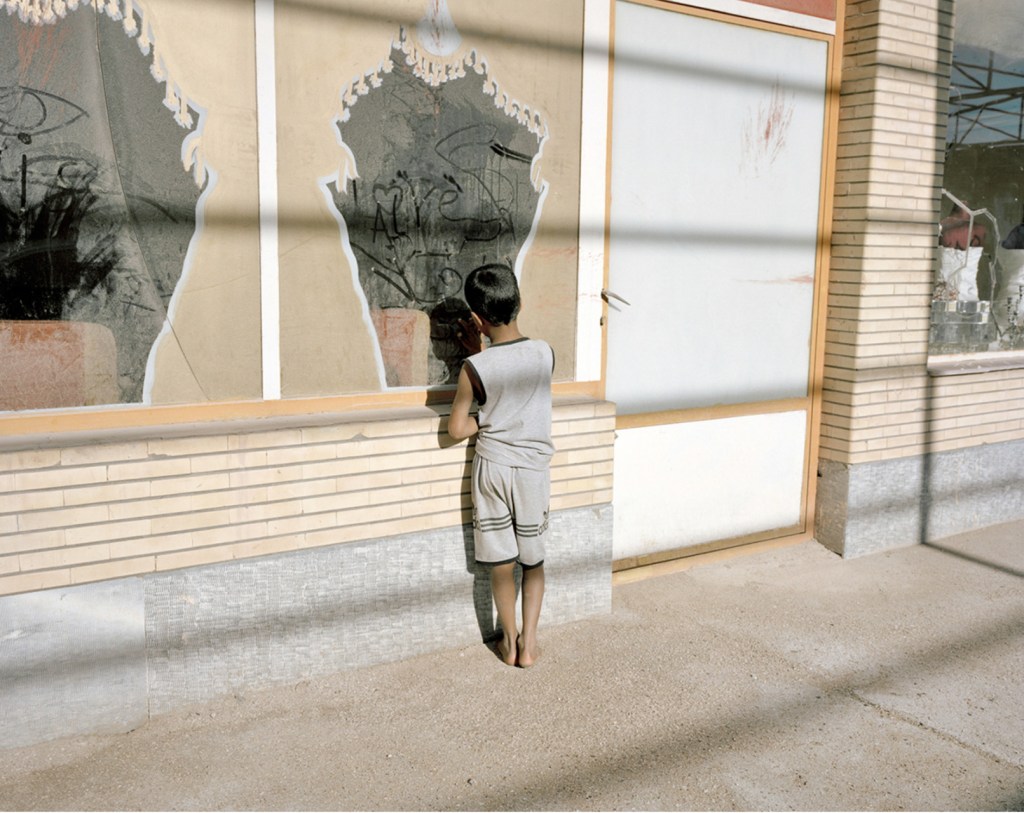
A curve is a broken line was on display at the Art Gallery of NSW from 22 September 2023 to 21 January 2024. I feel lucky that I was able to see it twice in the week it closed. The exhibition showed a series of photography works by Iranian-Australian artist Hoda Afshar including In the exodus, I love you more, Behold and Remain. Her images have a lyrical quality to them. Though every work speaks to a different theme, Hodar treats her subjects (human and inanimate) with great care, almost as if capturing them were a labour of love, regardless of her real-life relationship to them. The image of a young boy inspecting drawings carved out from a film of dust on an old window is just a couple of walls away from the image of a woman inside a religious space, her face obscured almost completely by an unseen source of sunlight piercing through the dark space. The landscapes where her subjects reside are equally evocative. What initially feels like a stark contrast actually somehow compliments the people whom she captures.
It feels almost simplistic to describe Hoda’s work as purely ‘political’. In maintaining a commitment to the people whose experiences she is sharing, Hoda collects stories for delicate display — they are not to be interrogated or debated or the source of a hot disagreement, even though her work may elicit this. There always seems to be a passion behind the cause which she doesn’t shy away from, and yet, in working to document the intimate struggles and horrors of people in precarious situations, there is something fragile and personal. Somehow it’s as if showing things through the altered lens of her camera has allowed the truth to hit home harder than as if it were a stark depiction of truth. The staged truth is harder to witness than the raw one.

The images from the series Behold were taken in an unnamed Iranian bathhouse; Afshar was invited by a group of gay men who had asked to be photographed. Despite the threat of persecution, the images are so delicately staged, allowing space for a forbidden eroticism to carefully blossom in the lives of the subjects. It may be tempting to overly romanticise this series or else to be ‘shocked’ by the intimate images, but instead, Hoda serves to remind us that these men are no more virtuous or sinful than anyone else. The portrayal of their carnal instincts act a mirror to those things within us which are often politely suppressed but emerge (or could emerge) in our most private moments.

Remain was filmed on Manus Island in Papua New Guinea. The work features several male asylum seekers, including the Kurdish-Iranian Behrouz Boochani and those who lived close to or knew Reza Berati, who was 23 years old when he was killed on Manus during a riot in 2014. One by one, the men walk slowly through the tropical ‘green hell’, the camera following them from behind, as the story of their experience is told in voiceover. This means that while we hear their voice, and the sounds of the forest, we never see their mouths moving. The poetic fragments written and spoken by the men, interspersed with their own personal stories, add another moving layer to the work. As we watch the men walk through the forest, it is with compassion, but it is also difficult to not feel complicit in some way. And so, though spoken calmly, the phrase ‘do not press your foot on me — I will drown you’ becomes as much an expression of resistance in the face of torture, as it does a warning.
In the last few months, global communities have been clouded by a justified obsession with the atrocities of war. And yet, if we consume news by scrolling and swiping, as many of us now do, we are rarely left with the opportunity to reflect but run the risk of being desensitised. Scenes from decimated hospitals filled with the wounded; men led, hands tied and blindfolded, into the unknown; the disembodied voice of a child begging for help over the phone, while gunshots surround her, until the call comes to an abrupt stop. Sometimes these are things we must watch or listen to with uninterrupted, undivided attention, and not interspersed with comparatively trivial content. Often, as painful as it is, we need to sit with the horrors if we are to take appropriate action to address them, however small our actions may be. If we can learn to get in touch with our own suffering as witnesses, we can expand our ability to engage with the enormity of those suffering as victims.
In Remain, one of the asylum seeker men recites, ‘I am a fool who is afraid of the sky.’ Our fear of our own mortality in the face of suffering without end reminds us painfully of our fragile existence. We may all feel insignificant from time to time in the context of the universe, its timeless vastness. But this does not mean a person’s life should ever be made to feel that way at the hands of another. Having lived through the offshore detention at the hands of the Australian government, Hoda’s subjects share a robust but profound reminder that ‘this fool knows one thing well, that he is a beautiful fool.’ Wouldn’t we all be a little better in this world for knowing this too.

 Gabriella Florek