Walking away from the precipice

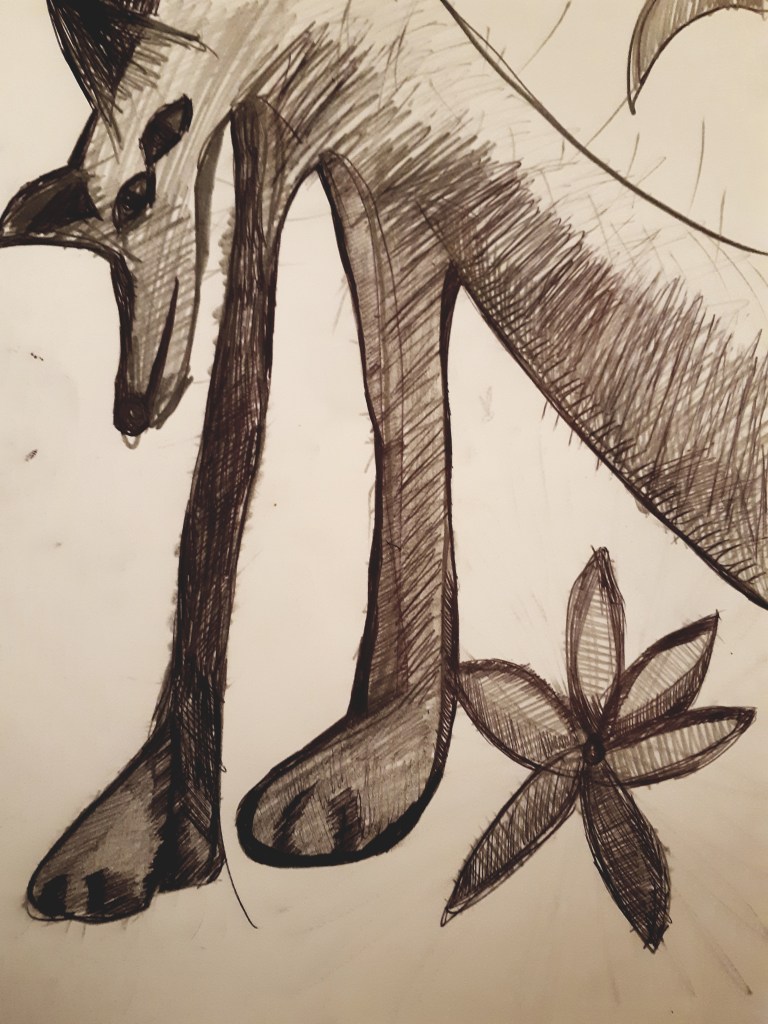
pencil on paper, man’s best friend with a flower

Firstly, a secret: it is my birthday in a few days

*

Wasn’t it Cate Blanchett who once said that it is always more interesting playing a character who is clinging to sanity than one who has gone entirely mad? In my short foray into actor training I held this idea especially close. In my everyday life I am perhaps less good at following it.

I should clarify something: I rarely consider myself mad.

Most of the time, I am high functioning; I am a perfectionist; I live my life with a kind of rigidity that means even my bouts of depression seem to arrive on cue. I certainly struggle, but I like to disguise the struggle as much as possible. Some people have mused that perhaps “I am not being vulnerable”. Perhaps they have a point. But actually, in my deepest and darkest moments, I don’t feel there is particularly much to be vulnerable about. All that exists in those times is blankness, darkness and a painful nothingness that doesn’t even warrant a desperate escape from. I am so numb during those times, that acts of violence or destruction do not even cross the threshold of my brain.

So what am I disguising then, if it is not depression? I have suffered this for over a decade after all and I like to think I’m quite good at living my life with it on my shoulders.

The disguise is for something greater and scarier I think. At least scarier in my mind…

*

On the phone with friend in my parents garden after returning home, I noticed a small spider, no bigger than the size of my pinkie’s fingernail. It was in the act of constructing a delicate web. The web itself was as big as the hand of a grown man, but the thread which connected it was at least a couple of metres long – running from the bottle brush on one end of the garden, to the banana tree in the fruit patch. Every now and then, a gentle gust of wind would blow, and the spider would halt it’s movement, pause, take a breath and then, once the wind has settled, continue to work, as though nothing had happened. I watched this act in awe and with a kind of melancholy. The spider sensed a good time to work and build its web, even though it could have it ruined at any given moment, by any clumsy low flying bird, or a jumping cat or, god forbid, a brute and unsympathetic human.      

I have no real ability to stop these things from happening. The spider’s web will not last forever, not matter how much I would like it too. But what I envy of the spider, is its ability to work fast, construct beauty, work without knowing whether the end will ever come to fruition, all in the hope that she may be able to catch something that she can claim as her own.

*

I talk a lot about the things I struggle with.

I talk less about the things I am good at and perhaps this is where the problem lies.

A “setback”, as big as what I have just experienced, would for many people cause them to lose a lot of time, energy, money, relationships and hope. In my case, I have somehow learnt to be emboldened by these setbacks. In fact, I don’t even register it as a setback, I register it as progress, as a chance to restart, refresh. I register it as freshly raked soil, as filtered water. Because what I have been reminded of in the last couple of weeks, is that I do have a community, I do have a home, I am loved and I am of value in the world.

And even if that value will one day cease, which it inevitably will, I can relish what I have while I have it. I can wallow in the muddiness of mess and success and pain and glory and friendship and love.

*

In a few days, I will be another year older. I hope for this upcoming year, this time, I will learn something slowly, in a less brutal way, in a way that doesn’t frighten others, in a way that doesn’t frighten myself, in a way that allows me to find something sustainable and less dramatic.

I’ve seen enough madness played by the great masters, the Hedda Gabbler’s, the Blanche DuBois’ or the lovely Sheba Hart’s. I know that they are not me. But I stand with them.

These women are my sisters, my friends, my mothers, my teachers. But I do not want to be them anymore than they deserve to be me.

I’m making my own gift for myself this year.

Happy birthday.
In the smallness: that’s where I found you

Last Monday I was invited to appear as a guest poet on Eastside FM, where I had the chance to have some of my poetry (read by yours truly) broadcast to a live audience and discuss the themes and ideas that inspired them. It was for an arts program called Radio Sympoiesis.

It was a humbling experience. I’ve always enjoyed writing poetry, but in recent years, I’ve rarely had a place to share them, certainly not to a live audience. In the program I mentioned early in the interview that I had been writing poetry since I was 9 or 10, but after some more reflection, I think my forays into poetry were earlier. I have a distinct memory of being around 6 when I showed a collection of my poems (which I still keep to this day, on the bookshelf in my childhood room at my parents house) to my beloved teacher, Mr Albanese. He took them away and gave them a read, and then we chatted about them in the playground.

Mr Albanese was a legendary primary school substitute teacher who helped our class collectively write a song about caterpillars turning into butterflies:

caterpillar, crunch, crunch, crunch
eating leaves, munch, munch, munch
pretty soon you will be free
flying through the trees

He was a kindred spirit.

So, about 20 years later I find myself on the radio discussing my own work, which has slowly and steadily evolved after many years of playful scribbling and crossing out and rewriting and improvising. I can’t begin to explain how quietly satisfying it is to put something small out into to world, and have other people revel in its beauty with you. Even if it only ever reached a few ears, even if only the mice and the birds and a couple of beloved family members and friends, this whole experience was warming and I am very grateful for it.

Here is a link where you can listen to an abridged version of the show which focuses on my poetry and the conversations inspired from them:
https://soundcloud.com/artemis-projects/sympoiesis-gabby-florek-eastside-radio-897fm

The four poems that were read on this program at the end of this blog post, so if you would like to reread them while or after listening, you can do so.

Thanks to everyone who has listened so far and again, thanks Ira for giving me the opportunity to read these to a live audience.

*

Snails like to ponder in puddles
thoughts lulled by the dull sounds of chewing.
Comments on weather exchanged over breakfast
because company enhances
the delectable foliage.

I keep faith that giant feet
will simply miss them in the grass
but their shells are never broken
they are the home of withered souls.

And when it’s raining softly
I can hear them humming gently.
They dream of turning green
just like a leaf
but they cannot
and so?
They eat the leaf instead.

*

“More people than planets will live in the sea
when fires are shattering houses and dreams”

The people who spoke this believed in the end
and the round about way we would die but befriend
all the dried flowers we pressed on our walls
who would really do nothing but willingly talk
about old times and good times and planets in skies
that lived in the heavens – before heaven died.

*

Somewhere between the rose water
(which you do not drink)
and the dogs’ bottoms
(that we sleep beside)
there is a reason to the tea I sip
(to help me settle)
And the way you like to wander naked through the house.

I took so little from the sky when I asked for rain to heal me
And even the flowers, I fear, could never know the sweetness of you.

I take your head into my dreams
your fingers into my hands
and you let you disappear into me
I look to you
And before your smile passes, I’ve swallowed memory of moonlight.

*

When the dogs cried
we let them love us more than before
and held them closely while we drove.

I couldn’t utter the final ultimatum
“it’s either me or the dogs”
but I felt like it sometimes.

Dogs are hard to be mad at when they lick you though.

And somehow, when I saw you in that light, looking at them solemnly
I knew I’d remember what they gave us
and their fur which lines the bed cover becomes less repulsive
and more forgivable.

Another tongue

First written in 2016

I speak only little by little
to the ants who carry their secrets on top of their prized crumbs.

I speak only in twitters
to the miners that nest among the orange blossom

And to the frogs, who ‘tock’ diligently in the rain
I sing to them underwater.

I have forgotten though
how to speak to the woman who makes dinner
It’s an easy pastime in my own language
but still, my tongue confuses itself
and my face burns blue .

I have forgotten
how to speak to the girl who lives a room away from me
whose painting I have hanging on my wall
and whose hair I know too well because even though I cannot touch it
it’s just like mine.

I have forgotten
how to hug the man who is wise and speaks in riddles
and sings silly ditties when it’s time for coffee.

I’d rather – sit among the prized crumbs
I’d rather twitter or sing beneath the water
and though I might drown, at least I’ll know
our misunderstandings are unpreventable
and I can sleep easy in forgetting them
when forgetfulness is all I can offer my brain


Bending towards the sun

A week ago, I told myself I would write a blog post about Elizabeth Fraser. I had it all planned out: it would start with a reflection of the song All flowers in time bend towards the sun which exists as a demo which was recorded by Jeff Buckley and joined by Elizabeth on vocals – it was never fully polished or released.

I was going to write about what a gorgeous piece of music it was and how the friend of mine who introduced me to it described it as “celestial.” I had never heard anything described of like that before but it made so much sense to me when I was listening to the song: of course this is the sound of the planets aligning.

I would then move to talk about my adoration for Elizabeth’s voice and how I have a Cocteau Twins playlist (which is the band she was a part of and recorded with throughout the 70s to the 90s) that I listen to songs from every week.

I thought if I was clever enough, I could turn the post into a kind of sophisticated music essay. I was so convinced about the subject matter, I found myself listening to the playlist while writing the post. Alas, I kept running out of things to say. I kept rewriting the same paragraph. I kept listening to the same lines in the same songs. I love Elizabeth’s voice but I didn’t know how to convey it fairly to the reader.

 *

Who are we but the stories we tell of ourselves?

For a very long time, I’ve been afraid of my story. But the fear, actually, hasn’t been known as “a fear of my story” it’s been disguised as something else. It’s been disguised as “a fear that I have no story to tell.”

I have spent a big portion of my life thinking that I am formless, weightless and without an anchor: that I am a blank canvas with a shitty memory, a perchant for forgetting everything that I read or watch. “There’s something wrong with my brain” I convince myself – if only someone could do a scan on it or something, they’d see my hippocampus or frontal lobes or amygdala were all out of whack. And yet – no one has perpetuated this narrative that “there is something wrong with me” more viciously than me.

There is an idea that I have learnt about from different books, friends and other wise souls, the idea that storytelling is validating. When we speak of our own stories or when we listen to those of others, we are sharing something fundamental about our existence. Whether we are revelling in shared pain, joy, resilience or suffering those stories strengthen and reassure us of our humanity.

You’d think someone who prides herself on writing and creating stories as much as reading them would have realised this long ago. Perhaps I did realise it. Perhaps I did know it – once. But somehow the narrative of a warped brain became the dominant belief and somehow having a warped brain seemed to overtake this idea that storytelling is important. What’s the point of telling stories if you don’t remember them anyway?  

*

In another, previous, earlier life of mine I wrote poems about my parent’s garden. I wrote about the pond, the frogs that inhabited them, the lizards, sunflowers, bees and herbs. The garden provided enough fodder for me to write my whole English Extension 2 project on it. For my major work, I submitted a suite of poems and a reflective essay on the work.

In this life, I had something to say and I was just starting to believe that if it could be spoken audibly and clearly someone might listen.

In this life, I had a belief that I was like a fistful of weeds growing in and around the shrubby, semi-unkempt but very fruitful and ever providing garden my parents tended. I was intrusive, but alive: I was persistent, I was green, I was hopeful. And no matter how many times people attempted to remove me – I regrew.  

In this life, I was unstoppable.

*

There are people that help you shift towards the sun. They help you face its blinding light and take nourishment from its rays. But, at the same time, as Elizabeth and Jeff remind us “All flowers in time bend towards the sun.”

I think this means that we know what’s good for us and we all grow towards it eventually.

I’d like to think I’m bending there slowly but steadily.

This little life of mine has been shaped by suffering and resilience, by distance and intimacy, but flowers and soil. I cannot tell you that every day I notice the sun, but I can tell you that every day, I warmed by it and made alive from it. In our orbit around the sun, there is something so promising – so honest and so utterly, devastatingly real.

Who told you that there has to be a reason? There only needs to be sun and from it, there will be life: the celestial bodies moving in our corner of the universe have told us that all we needed was light and then anything is possible. If I can tell you about the sun, I can tell you about my story – just as Elizabeth Fraser tells me about hers. And just as I listen to all the ecstasy, suffering and misunderstandings about life that I have learnt from other people – I think I am beginning to realise I can learn things from my own. I can look inwards without falling to pieces and find that the light that gave me life, lives in my petals.

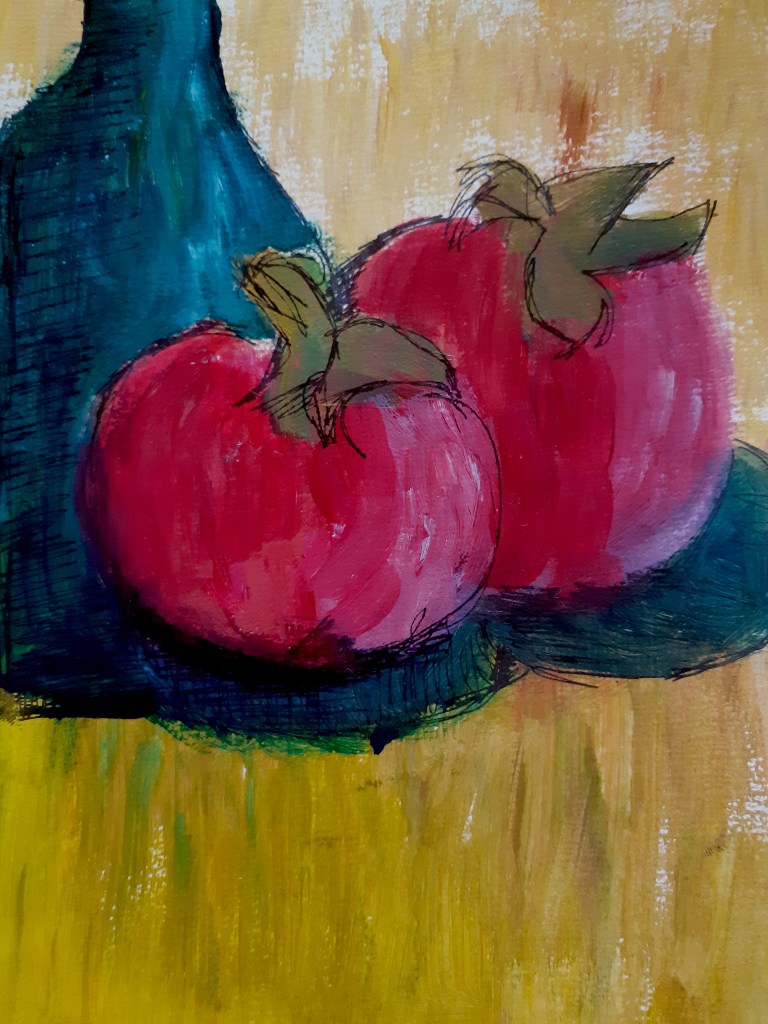
Still life is life still

Ok, so perhaps this is cheating slightly because I didn’t paint this still life from a model arrangement – I kind of imagined it myself. I had hoped that the red fruit look a bit like pomegranate and the bottle is a little small and out of proportion AND of course, there isn’t much difference between the yellow benchtop and the yellow wall.

It would definitely be a nice challenge to one day paint what I see rather than what I imagine is nice to paint!

But all of this – is forgivable.

Bird watching and squownkers

It all started after a move last year when my housemate and I made the difficult but life affirming decision to leave our very well loved share house and venture out into the world of two bedroom apartments. We decided to stay in the same suburb – our new apartment was only a 15-minute walk down the road from our old place.

It was unsettling acquainting ourselves with a new place. The neighbourhood on this side of town looked different, the walls in our apartment seemed thinner than our previous house, we missed our old neighbours’ kids and we had to adjust to the longer trek it took to collect our groceries.

With the arrival of spring came something unexpected. I soon became familiar with a blood curling, demonic screech or, as I later described it to a friend in gentler terms, “a cross between a squawk and a honk.” My friend humorously suggested that the word I was looking for was “squownk” and I thought that was possibly the funniest but most accurate word I’d ever heard.

The bird (what else could it have been?) seemed to love the big tree in the backyard opposite ours. From my bed, I used to spend, and still do, many afternoons admiring the green vista that replaced the brick wall I had to stare at from my previous room. But this new bird cry, which I heard almost every day, sometimes in the morning, occasionally in the afternoon, at times at dusk and often in the middle of the night, kept me intrigued but slightly guarded. Of course, the whole mystery was heightened by the fact I couldn’t see the creature that was emitting it.

What followed was a relentless attempt to catch the bird out. When I heard, it I would rush to the nearest window but I never saw it through the thick foliage that blocked out large bits of the sky where I imagined it was flying through. Once, as I was walking to the bus stop, I saw and heard the bird squownking away in flight right above me. I craned my neck to look at the thing but all I could see was its underside which from my angle made it appear like an abnormally large, misshapen, fat pigeon. Squinting, I watched it flap its wings and disappear off into the distance.

I found myself reciting my close encounters with the unknown bird to friends and family. Some lucky people were provided regular updates on the status of my investigation. I wouldn’t say I was obsessed – but I did come realise that my interest in the bird was more than just regular curiosity.

I’ve always been fond of birds: kookaburras, galahs, corellas and cockatoos. I know that mudlarks and butcherbirds aren’t baby magpies. I’ve identified strange parrots in the park at the bottom of our suburb and I know the difference between an Australian minor and the introduced species. I’ve seen a family of emus in the wild and took a careful, gentle interest in the baby plover on our street. But for some reason, I couldn’t reconcile my frustration with this bird.

After months of relentless curiosity, sharing stories and many desperate runs to the window, I was rewarded with a lead. Although I had attempted to Google the bird before, this time my particular combination of search words pointed me to the direction of the Channel Billed Cuckoo. I was elated and relieved: now I could put a face to a sound and I of course made sure to update my friends with this, what I thought was, life changing news. It was a kind of closure I had long since yearned for but had almost given up on securing.

*

Last weekend when I was on the balcony hanging some towels, I heard a rustle in the tree next door. A careful glance over revealed to me a very strange-feathered body sitting on a branch. With a longish brown patterned tale and an odd looking hooked beak, I wondered if this was the strange bird that had evaded me for the last several months. I stood watching, entranced: “squownk for god’s sake – just squownk and we can put this thing to bed!” But the squownk never came. I just stood there stupefied, and as if it knew it was being watched, the bird rustled around gently, never fully revealing itself, never emitting its infamous cry, just hopping from branch to branch immersed in it’s own birdy business. 

Was it fate? Was it the universe prompting me to pause my search or restart it with renewed vigour? Was the bird a sign? And if so, for what?

I may never know.  

There wasn’t any turkey this year but I felt like crying over it nonetheless

Christmas can be a difficult time of year when you are prone to bouts of sadness and critical self-reflection. Comic episodes can invoke a sense of inadequacy, joyous moments can trigger sorrow and the rest of the absurdities can make you feel isolated. It’s nothing to do with how loving your family is or how caring the community is that you find yourself surrounded by – if you feel shitty and alone, you just have to acknowledge it and ride it out. 

Despite feeling relatively flat over the last few days, I managed to make a few fragmented observations. For me it was important to record the small things – however humorous, small or apparently unimportant that happened over the Christmas period.

*

“How about we come to you so you can sit down in the photo?”
“No – I don’t want to look old” says our elderly family friend and we watch her stand somewhat shakily and make her way over to us for a photo. She is decisive and strong willed and although we are meant to be keeping our distance because of COVID, she puts her arm around my shoulders and holds me close. I try not to breathe.

*

Mum and I take a walk around the neighbourhood. We make the usual observations: which garden we like the best; how much the house on the street next to us is selling for; we admire the newly renovated and ponder over the dilapidated. We pass a house with a veggie garden in the front and a stocky dog – medium size, comes to observe us at the fence. Once, there used to be a sign at the front of the house advertising a clairvoyant. Mum does something odd – she makes an uncharacteristic bark sound and sticks her hand in a groping motion towards the animal. It’s a provocative move for someone who fears being barked at. The dog seems so stunned that it isn’t until we have long passed that he decides it’s worth yapping, but it’s a half hearted effort.

*

My sister and I pass the afternoon playing Scrabble to modified rules. It ends up being more competitive than planned, and by the end of the game I’ve given up – although by that stage I’ve won by a healthy margin of points. I don’t quite acknowledge the fact that she has beat me at a previous game of Speed so even though we’ve both won one game each I pretend I’ve come out on top. 

*

After Christmas hot chocolate and Panettone for breakfast, I crawl back into bed and fall asleep. Sleep comes easy but I feel foggy and slow trying to wake up. After multiple visits from all members of the family who ask if I’m ready to open presents, I hear a bell from the living room and the crinkle of wrapping paper. I stumble out of bed groggily and plonk myself down on the couch ready to observe everyone’s gift opening reactions. Dad has his camera ready but Mum insists she doesn’t want to be photographed without her made up eyebrows.   

*

From the backyard at my parents place, my sister spots a black cockatoo. I hear the bird just moments before my sister calls to us. It has a very distinct cry, more like a screechy seagull than a cockatoo to the untrained ear. When I open the back door to see if I can glimpse it, I see my sister standing at the top of the yard smiling up at the tree in our neighbours yard. I follow her gaze and see it perched on a tall pine. Within a few moments, it’s swooped by a native minor, and the bird spreads its large dark wings and makes a sudden, sharp descent, shrieking as it does before it accelerates upwards towards the sky

*

Rihanna and Kings of Convenience accompany my sister and I as we cook dinner. One pot is for normal wheat pasta, and the other hosts a gluten free kind. We prepare salmon with zucchini and carrot to stir through the pasta when it is ready. Afraid of tastelessness, my sister scrounges around the freezer for some frozen chilli we can use in our dish. She finds two whole frozen ones. I cut up one chilli roughly, seeds and all and throw it into the pan with the fried stuff.   

*

“You better watch out, you better not cry, you better not pout I’m telling you why” sings the old but not forgotten Santa that has graced every Christmas gathering for the last 20 years. We watch him slowly amble along the white tiles while he sings in a monotonous drawl. He may well be the darkest, most depressing Christmas character but is dutiful none-the-less. In the face of repetition and having fun poked at him, he takes it all in stride (or crawl) and does what he’s done in the only way he knows how – survive, slowly and surely but still survive.   

Pearly Blacks

First published 2018 with Sweatshop in The Big Black Thing: Chapter 2

When the wind has finally brought her home from her play in the sun, my sister stands confidently in her chubby little frame upon the living room table and begins to dance. Knees bent, bottom jutting out, she moves side to side in a simple Latin two-step, eyes closed as though she is in silent meditation.  

I peer at her through a crack in the living room door. The smell of fried beef mixed with onion and fresh tomato fill the air and I pray to our Spanish-speaking God (who has a furry face and large brown hands) that Mum doesn’t see me hovering around the living room door ajar. Spying on your sister isn’t a good enough excuse to have the house smelling of Saltado.

I try to pick out the music in her head. Something our dad would play on repeat, a Susana Baca rhythm where Susana summons the Afro Peruvians to a call and response amidst a strumming charango. My sister holds her hands up to the sky and tilts her head back. She is in the throes of laughter. And balanced on the outstretched palm of her right hand, a rotting, black little molar sits defeated – silent and unmoving. I remember how long it took for that uncoordinated hand to be able to finally catch and throw, hit and slap. Now it is chubby and completely still. The molar stands upright as though it has placed its roots in my sister’s hand and sprung up from her sweaty skin – a black thing clawing into her like a beetle with spiny legs. This is no accident. For months, I’d seen my younger sister carefully brushing all her teeth with the same love and dedication, except for a single molar in the back left-hand corner of her mouth. My grandmother, who we only ever call Abuela, cursed my sister for neglect, and swore at her in Spanish before taking out her dentures for a torrent of toothless abuse. This display was meant to frighten her, ‘Look what you will become – a witch without teeth, una bruja sin dientes’, but all it seemed to do was strengthen my sister’s resolve.

Mum won’t admit that Abuela knows something is afoot before her. Once she finds out about my sisters’ rotten tooth, she will turn to my father. ‘It’s all that lemon with sugar you let them eat.’ She won’t admit she has the recipe down in her cookbook, a simple way to please us kids. Good Mums don’t glue their children’s teeth together with sugar, and she’ll go to the grave denying she ever did.

Mum would cut the lemon in half with the big knife from the draw, with that dexterity and command that told the world she owned the kitchen. The lemon would stand face down, waiting for the sweet, white granules to be measuredly poured beside it. The trick is to squeeze the lemon slightly when dipping it into the sugar, so that the juice breaks through the flesh, and the sweet stuff sticks faster. Then it’s clenched-up faces and eyes rolling into the back on your head and sneaking more sugar onto the plate until the juice of the lemon is gone.

From the upside-down room at the other side of the house, I can hear my Abuela crying. Since she arrived from the other side of the world smelling like leather and talcum powder and I wonder if she always smelt that way. The foot of the bed blocks the door to the upside-down room so you can never open it all the way; you have to stick your head right around to say hello. If you lie upside-down on the bed, head facing the window you can see the jacaranda flowers falling from the sky. I imagine my Abuela lying on her bed the right way up, her small, shrivelled body stretched out so that she is touching the window frame with her alpaca wool socks, even though it is summer. She has no interest in the purple flowers – she is waiting to be comforted, waiting to hear that she was right about my sister’s tooth all along. As though my mum has heard her weeping, the sizzling from the Saltado gets louder – she starts the stove fan.

Eyes on my sister, I am concentrating all my energy on her chubby little fingers squeezing the tooth in triumph. The door squeaks. My sister stops, looks me straight in the eye and smiles; her blood-stained canine smile. But there’s a reason why you shouldn’t smile and dance at the same time. Dancing is not for celebration – it’s for mourning. Susana Baca and her African troupe could tell you that.

I watch my sister, legs spread, pigeon toed, and bottom out, ready to go again. She shuts her eyes, the rhythm in her head starting over, still smiling. I see it before it happens. The tooth slips from her fingers and she scrambles to catch it. She falls hard, face on table. I hear frying from the kitchen, crying from the upside-down room. My sister lifts her curly head up and as she does a shower of perfect baby teeth fall to the floor. I imagine the brown handed God contemplating me from above. I laugh, relieved – the falling of my sister’s teeth will mean I’ve stopped her from falling somewhere worse; from her bike, from the Jacaranda or into the water that she is just learning to tolerate.  

Tweedle dee and beetle tweedle

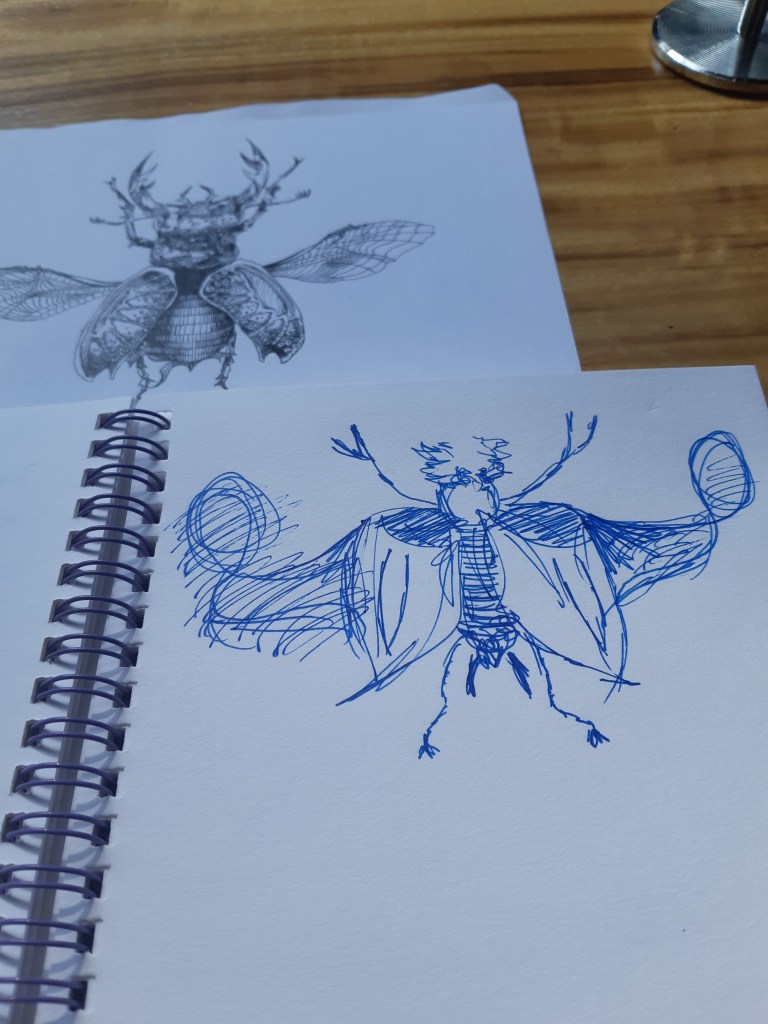
Use a reference but draw your own

I sketched this beetle last summer when I was at a cafe in the city near the giant chess board in Hyde Park. I had recently picked up the print of a beetle from a young artist on Pitt Street. He was handing them out for free.

I loved his version of a beetle but I wanted to draw my own – half inspired, half imagined.

I don’t think the sketch is quite finished, but it was so satisfying and fun to draw and I’m oddly content with its half finished form. Sometimes the pressure of sharing work with someone else hinders my ability to enjoy the process of creating work in the first place. Finished products are good – but so are playful sketches.